
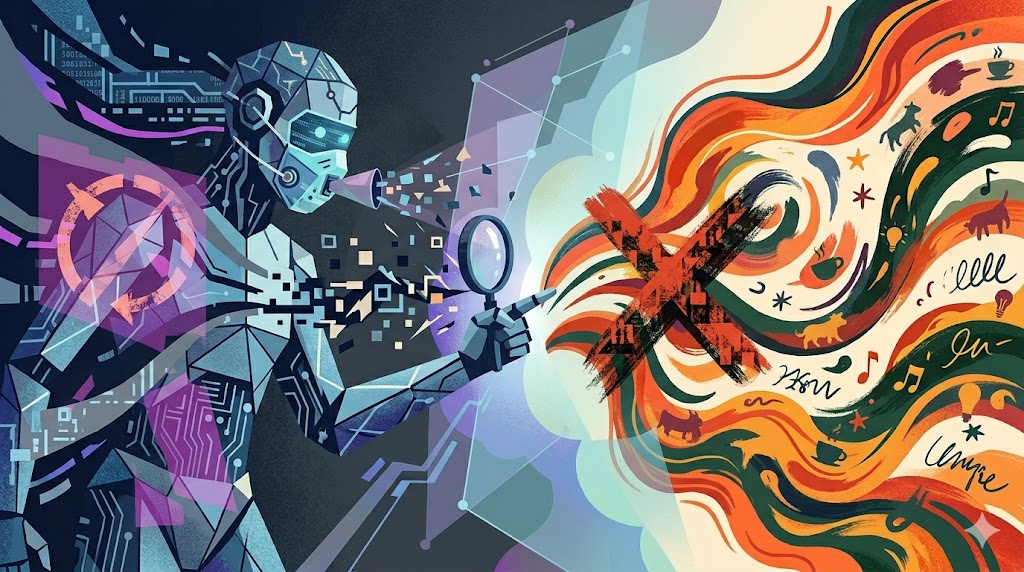
Everyone Can Tell You Used AI. Here’s What They’re Actually Detecting.
The fear of being caught using AI for content is real, and it’s not irrational. People are getting better at detecting it. There are tools designed specifically to flag AI-generated text. And there’s a social cost to publishing something that’s obviously generated — it signals that you either didn’t have time to write something real, or that you don’t care enough to.
But here’s the thing worth understanding: what people are detecting isn’t AI use. It’s generic output.
What the tell actually is
When someone reads a piece of content and thinks “this was written by AI,” they’re responding to a specific set of signals. The same sentence structures repeated throughout. Phrases that show up everywhere — “it’s important to note,” “in today’s fast-paced world,” “let’s dive in.” Enthusiasm that doesn’t match the topic. Hedging on everything. A perspective that could belong to anyone.
None of those signals are caused by AI. They’re caused by content that wasn’t written from a specific point of view, with specific examples, in a specific voice. AI produces that kind of content by default — but a person can produce it too, and people do, constantly. The generic LinkedIn post, the boilerplate newsletter, the blog article that could have been written by any of fifty people in the same industry.
What people are detecting is the absence of specificity. Not the presence of AI.
Why this matters
It matters because it means the question isn’t whether to use AI. It’s whether what you publish sounds like you.
If you use AI and the output is specific — real examples, a real perspective, a voice that’s recognizably yours — people aren’t going to flag it. They’re going to read it. The content either earns their attention or it doesn’t, and that comes down to whether there’s something in it that only you could have written, not whether a human or a machine did the drafting.
If you use AI and the output is generic, people will notice. But they’d also notice if you wrote something generic yourself. The AI didn’t create that problem. The missing specificity did.
What makes content specific enough to not trigger the detection
Real examples. A story with the specific weird details that only come from something that actually happened. The name of the city, the unexpected thing that went wrong, the observation that only someone who was there would make. AI will fabricate examples that are plausible but generic — close enough to feel real, specific enough to feel invented. Your real examples are what replace those.
A real perspective. Not the balanced take, not the safe take, not the take that a reasonable professional in your field would agree with. Your actual view, at your current level of knowledge and experience, stated at the confidence level you’d actually claim it. Generic content hedges everything. Specific content takes positions — even small, carefully qualified ones — because a real person is behind it.
A recognizable voice. The sentence rhythm that’s yours. The phrases you actually use. The things you’d never say. The way you open a piece and close it. These are the things that make content identifiably from one person rather than from the category of “content marketing professional.” AI can be trained to replicate them. Without that training, it defaults to patterns that belong to no one.
The practical implication
If you’re worried about people detecting your AI use, the solution isn’t to stop using AI. It’s to stop using AI without training it on your specific voice and giving it your real examples to work with.
The content that gets flagged is content that could have been written by anyone. The content that doesn’t is content that could only have been written by you — even if AI did the drafting, because AI was working from your voice, your examples, your perspective.
That distinction comes down to setup. A voice profile that teaches Claude your patterns and hard rules. A content process where your real ideas and examples go in before the drafting starts. Those two things close most of the gap between AI-generated content that gets detected and AI-assisted content that just reads well.
The Aligned Voice Profile is the starting point — a fifteen-minute interview that builds the voice profile for you and generates the file automatically for $37.
If you want to understand what goes into it before you commit, this article covers the full breakdown. And if you want a complete content system rather than just the voice layer, book a discovery call and we can figure out what makes sense.
Related reading:
What Small Business Owners Need to Know About AI Content
How to Use AI for Content Without Losing Your Authentic Voice
Why AI Content Sounds Like AI (And How to Fix It)
One Comment